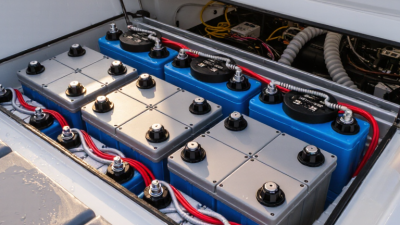
Lithium Marine Batteries are changing how boats store and use electrical energy. Unlike traditional lead-acid banks, they use lithium-ion cells to move lithium ions between a cathode and an anode. This electrochemical movement creates usable current for propulsion, navigation, refrigeration, and onboard electronics. The process sounds simple. The engineering is not.
The International Energy Agency’s Global EV Outlook 2024 reported that lithium-ion battery demand exceeded 750 GWh in 2023, rising by about 40% from the previous year. The same report noted a 14% decline in average battery pack prices during 2023. Marine systems can cost more because they require sealed enclosures, monitoring hardware, cooling strategies, and marine-grade installation. DNV’s Maritime Forecast to 2050 identifies battery-electric and hybrid systems as practical options for selected short-distance vessels, especially ferries and service boats. Long voyages remain difficult.
Inside a marine battery, a battery management system monitors voltage, temperature, current, and cell balance. It can limit charging when temperatures rise or disconnect the pack during dangerous conditions. Lithium iron phosphate chemistry is common because it offers strong thermal stability and long cycle life. However, chemistry alone does not guarantee safety. Installation quality matters. So does ventilation, charging equipment, cable protection, and compliance with relevant marine standards, such as ABYC E-13 or applicable IEC requirements. A boat may gain quieter propulsion and more predictable power, but range still depends on hull weight, sea state, speed, and hotel loads. That distinction is easy to miss. The promise is real, but the assumptions deserve testing.
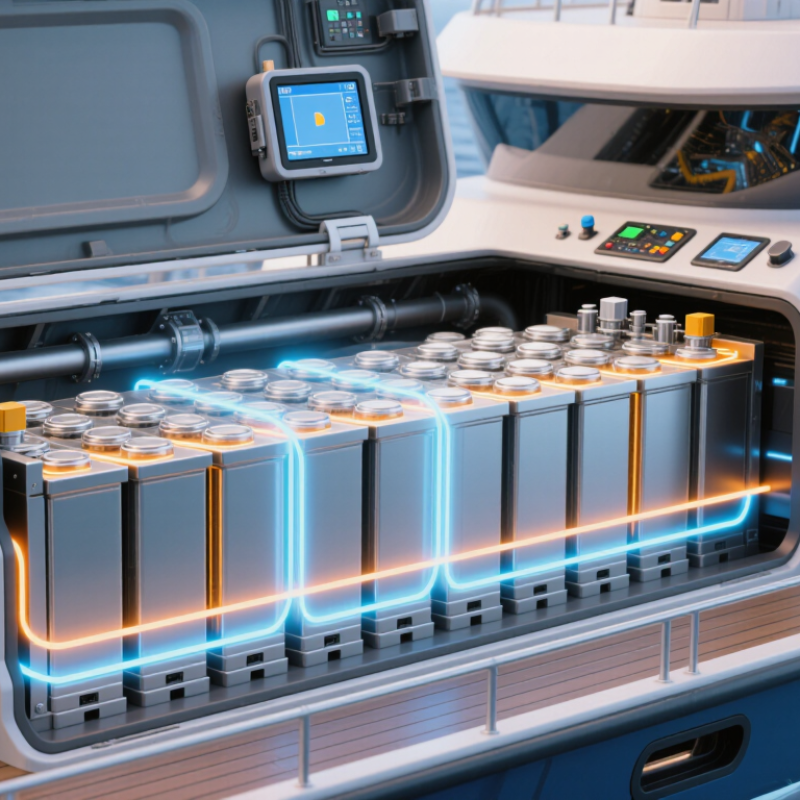
Lithium Marine Batteries: What Are They?
Lithium marine batteries are rechargeable energy-storage units built from multiple lithium-ion cells. Most deep-cycle marine models use lithium iron phosphate chemistry. This chemistry offers strong thermal stability and long service potential. A battery-management system watches each cell’s voltage, temperature, and current. It can balance cells or disconnect the pack during unsafe conditions. In practical terms, the battery is not just a box of cells. It is a controlled electrical system.
Compared with lead-acid banks, lithium systems usually deliver more usable energy from the same rated capacity. They also hold voltage more steadily during motor or inverter use. The International Energy Agency reported a 14% fall in average lithium-ion pack prices during 2023. Its 2024 outlook placed the average at 139 dollars per kilowatt-hour. That figure is not a marine retail price. It still shows why onboard storage is becoming more accessible. DNV’s Maritime Forecast to 2050 identifies batteries as practical for shorter, predictable voyages with reliable charging.
Charging matters. A lithium bank needs a compatible charger, correct voltage limits, and protected cabling. The BMS provides protection, but it cannot repair poor wiring. Cold charging can also damage some chemistries, depending on design. Not a simple swap. A capacity label may look impressive, yet real range depends on speed, weather, propeller load, and onboard appliances. The numbers help, but they are not the whole trip.
Lithium marine batteries store energy inside electrochemical cells. Lithium ions move between the anode and cathode during charging. During discharge, that movement creates a steady electrical flow. Cells connect in series for higher voltage and in parallel for greater capacity. A battery management system monitors voltage, temperature, and current continuously.
The system delivers power through a controlled discharge path. It can run navigation equipment, refrigeration, pumps, and electric propulsion. Unlike lead-acid batteries, lithium systems maintain a flatter voltage curve under load. That means fewer sudden power drops near the end of a trip. BloombergNEF reported an average lithium-ion pack price of about $139 per kWh in 2023. Lower costs are improving marine energy storage, although installation remains highly dependent on vessel design.
Charging is more precise than simply connecting a larger charger. The charger follows defined voltage and current limits, while the management system can reduce or stop charging when conditions become unsafe. DNV’s Maritime Forecast to 2050 identifies battery-electric systems as increasingly practical for shorter marine routes. Heat, saltwater exposure, ventilation, and cable sizing still demand careful engineering. Real boats complicate the theory. A poorly balanced load can waste capacity quickly. An undersized cable can also create dangerous heat. The battery may be advanced, but the surrounding system is not automatically perfect.
What Are Lithium Marine Batteries and How Do They Work?
A lithium marine battery is a controlled group of rechargeable cells, not simply a lighter lead-acid battery. Most marine systems use lithium iron phosphate cells because they offer strong thermal stability and long cycle life. The cells store energy through moving lithium ions. A battery management system, or BMS, monitors voltage, current, temperature, and state of charge. It can disconnect the pack when conditions become unsafe.
The internal structure matters on a wet, vibrating boat. Cell groups connect through busbars, while fuses protect cables from dangerous overcurrent. Temperature sensors sit near the cells, where heat can build during rapid charging. A sealed enclosure helps resist spray, salt, and condensation, but “sealed” does not mean installation is maintenance-free. Loose terminals and poor ventilation can still create problems. That assumption is too simple.
Industry data shows why this technology is expanding. The International Energy Agency reported that global lithium-ion battery demand reached about 750 GWh in 2023. BloombergNEF reported an average battery-pack price of 139 dollars per kWh in 2023, a 14% annual decrease. These figures cover many sectors, not marine batteries specifically. Marine performance can differ because charging habits, ambient heat, and vibration are harsher. A practical inspection should check cable torque, BMS warnings, enclosure damage, and charging temperatures. Small details matter.
| Component or Specification | Category | Typical Materials or Values | How It Works | Importance in Marine Use |
|---|---|---|---|---|
| Lithium-Iron-Phosphate Cells | Energy Storage | LiFePO₄ chemistry; approximately 3.2 V nominal per cell | Stores and releases electrical energy through the reversible movement of lithium ions between the cathode and anode. | Provides stable operation, high usable capacity, and strong thermal and chemical stability compared with many other lithium chemistries. |
| Cell Configuration | Electrical Design | Four cells connected in series for a nominal 12.8 V battery | Series-connected cells add their voltages while maintaining the same ampere-hour capacity. | Matches the nominal voltage used by many marine electrical systems while allowing a relatively compact battery design. |
| Cathode | Cell Chemistry | Usually lithium iron phosphate, commonly represented as LiFePO₄ | Accepts lithium ions during discharge and releases them during charging. | Supports a stable voltage profile and reduces the risk of thermal runaway compared with less stable lithium chemistries. |
| Anode | Cell Chemistry | Typically graphite-based carbon | Stores lithium ions when the battery is charged and releases them toward the cathode during discharge. | Enables efficient charge and discharge cycles with low memory effect. |
| Electrolyte | Ion Conduction | Non-aqueous lithium salt solution or gel | Allows lithium ions to move between the cathode and anode while preventing direct electronic contact between them. | Maintains the internal electrochemical reaction required for propulsion, electronics, lighting, and onboard equipment. |
| Separator | Safety Layer | Microporous polymer membrane | Separates the cathode and anode while allowing lithium ions to pass through. | Helps prevent internal short circuits that could damage the battery or create a safety hazard. |
| Battery Management System | Control and Protection | Electronic monitoring and switching circuit | Monitors cell voltage, current, temperature, and state of charge; it can disconnect the battery when unsafe limits are reached. | Protects against overcharging, excessive discharge, overcurrent, short circuits, and abnormal temperatures. |
| Cell Balancing Circuit | Voltage Management | Passive or active balancing electronics | Corrects voltage differences between individual cells during charging or operation. | Improves usable capacity, consistency, and long-term battery performance. |
| Current and Temperature Sensors | Monitoring | Shunt, Hall-effect sensor, and temperature sensors | Measures electrical current and internal or external temperature so the management system can make protective decisions. | Helps identify overloads, overheating, charging problems, and inaccurate state-of-charge conditions. |
| Protective Enclosure | Mechanical Protection | Rigid polymer or coated metal housing with insulated terminals | Holds the internal components in place and shields them from impact, vibration, dust, and accidental contact. | Supports installation in a vibrating, humid, and space-constrained marine environment. |
| Terminal Posts and Busbars | Power Transfer | Corrosion-resistant conductive metal connections | Transfers current between the internal cell assembly and the vessel’s electrical system. | Proper sizing and secure connections reduce voltage drop, heat buildup, and connection-related failures. |
| Nominal Voltage | Electrical Rating | 12.8 V for a common four-cell LiFePO₄ battery | Represents the approximate average operating voltage of the battery rather than a fixed output voltage. | Provides compatibility with many 12 V marine circuits when the charging equipment is designed for lithium batteries. |
| Usable Depth of Discharge | Performance | Often up to approximately 80–100%, subject to the battery manufacturer’s limits | Describes the portion of rated capacity that can be used before recharging. | Allows more of the stored energy to power equipment without the voltage dropping as quickly as with many lead-acid batteries. |
| Cycle Life | Service Life | Commonly several thousand cycles under controlled conditions | One cycle represents the equivalent of a complete charge and discharge; actual life varies with depth of discharge, temperature, and charging practices. | Can reduce replacement frequency in applications with frequent daily cycling. |
| Charging Requirements | System Compatibility | Lithium-compatible charger, alternator control, or charge controller | Uses a controlled constant-current and constant-voltage charging process with protection against overvoltage. | Correct charging equipment is essential because charging profiles designed for other battery chemistries may be unsuitable. |
| Low-Temperature Charging Protection | Environmental Safety | Temperature cutoff or integrated heating system, depending on design | Prevents charging when the cells are below the permitted temperature range, since lithium plating can occur during cold charging. | Protects battery life and safety in cold-weather boating conditions. |
| Energy Density | Physical Efficiency | Generally higher than comparable lead-acid systems | Stores more energy per unit of mass or volume than many traditional marine battery technologies. | Reduces vessel weight and frees space for other equipment or additional energy storage. |
| Discharge Voltage Stability | Operating Behavior | Relatively flat voltage curve through much of the discharge cycle | Maintains a more consistent voltage until the battery approaches a low state of charge. | Helps sensitive marine electronics and electric motors operate more consistently. |
Note: Actual voltage, capacity, current limits, temperature range, cycle life, and protection features vary by battery design. Always follow the battery manufacturer’s installation, charging, ventilation, and safety requirements.
Lithium marine batteries store energy in lithium-ion cells, then release it through a battery management system. The system monitors voltage, temperature, and current in real time. This matters on a boat. Heat and vibration are constant companions.
When propulsion is needed, the battery sends direct current to an inverter or motor controller. The controller converts that energy into smooth motor power. At the helm, acceleration feels immediate and quiet.
There is no fuel smell, and less engine vibration reaches the deck. Lithium iron phosphate chemistry is widely considered suitable for marine use because it offers strong thermal stability and a long service life. Still, installation quality decides much of the outcome. Poor cable sizing can create heat, even with advanced cells.
The International Energy Agency reported that global battery pack prices fell 14% in 2023. That broader market trend is improving marine energy storage economics, although vessel costs remain higher than household systems. DNV’s Maritime Forecast to 2050 identifies batteries as practical mainly for shorter routes and vessels with predictable charging access.
That limitation is important. A small harbor boat may recharge from shore overnight, while an offshore cruiser needs careful reserve planning. ABYC E-13 also emphasizes battery management, fusing, ventilation, and secure mounting for lithium installations.
Real-world testing should include cold starts, heavy loads, and emergency isolation. The numbers look promising. The sea is less forgiving.
Lithium marine batteries store energy through lithium cells controlled by a battery management system, or BMS. The BMS monitors voltage, temperature, and current during operation. This protection can disconnect the battery when unsafe conditions appear. However, it cannot correct poor wiring or careless installation.
Safety begins with secure mounting and correctly sized cables, fuses, and terminals. Keep the battery dry, protected from movement, and away from direct engine heat. Lithium batteries normally produce no harmful gas during regular use, but damaged cells can become dangerous. Stop using a swollen, hot, leaking, or physically damaged battery. Do not open the casing. A professional inspection is safer. No checklist catches every installation mistake.
Charging requires a charger programmed for the battery’s chemistry and voltage. Never rely on a general charger without checking its settings. Charging below freezing can permanently damage some lithium cells, so a temperature sensor or low-temperature cutoff is important. Watch for unusual heat, alarms, or repeated charging interruptions. A voltage reading alone can mislead you.
Maintenance is simple but not optional. Inspect connections for corrosion, check cable tightness, and review BMS alerts regularly. Before seasonal storage, remove unnecessary loads and follow the maker’s recommended charge level. A partly charged battery is often better than leaving it completely full for months.
I sometimes underestimate small parasitic loads, especially from monitoring equipment. They can slowly drain a system when the boat appears switched off.